Every time I talk to a CEO or COO of a growing company, the conversation hits the same wall. They know their operations are held together with duct tape. They know their team spends too much time on tasks that should be automatic. They even know roughly what the fix looks like.
Then they look at the price tags for Salesforce, SAP, NetSuite, and custom development from a big agency. The numbers start at six figures and go up from there. So they close the tab, go back to their spreadsheets, and tell themselves they’ll figure it out when they’re bigger. If you’re running a manufacturing operation, there’s a more specific breakdown of why those platforms don’t fit companies your size.
That gap between “I know I need better systems” and “I can actually afford better systems” is where most SMBs get stuck. Sometimes for years. I’ve seen companies doing $15M in revenue running critical operations on Google Sheets because they assumed the alternative was a $200K software project. It doesn’t have to be.
Why enterprise software doesn’t fit SMBs
Enterprise tools are designed for companies with 500 or 5,000 employees. The implementation alone takes months. You need a dedicated team to manage it. The licensing fees are built for budgets with a lot more zeros than yours.
But the real problem isn’t the cost. It’s the fit. Enterprise software comes with assumptions about how your business works. It has rigid workflows, predefined fields, and a structure that assumes you have departments with clear boundaries and a full-time IT team to configure everything.
A 30-person wholesale distributor doesn’t operate like a Fortune 500 company. A field services company with 45 employees doesn’t need SAP. They need something that matches how their team actually works, with their quirks, approval chains, and reporting needs.
I’ve watched companies try to make enterprise tools work at the SMB scale. They buy the software, spend six months configuring it, realise it still doesn’t fit their workflow, and then build spreadsheet workarounds on top of the enterprise system they bought to eliminate spreadsheet workarounds. It would be funny if it weren’t so expensive.
Off-the-shelf tools cover maybe 80% of what you need. The problem is always that last 20%. That’s where your competitive advantage lives, and it’s the part that generic software can’t touch.
What affordable automation actually looks like
Major is a Spotify marketing agency based in Europe. They manage playlists for over 100 record labels and studios. They were growing fast, but their operations were a mess.
Campaign data lived in separate spreadsheets. Every week, someone on their team spent hours pulling numbers from different sources and stitching together reports for each label. The labels themselves had almost no visibility into how their campaigns were performing. They’d email Major, Major would pull the data, format it, and send it back. Multiply that by 100+ clients, and you can imagine what the team’s week looked like.
Reporting alone was eating a massive chunk of their time. Just the mechanical act of pulling numbers out of spreadsheets and putting them into a format that clients could read. No analysis, no strategy, just data wrangling.
And because their team was buried in reporting, they couldn’t take on more clients without hiring more people. Every new label they onboarded meant more spreadsheets, more reports, more emails. Their revenue was growing, but their margins weren’t, because every dollar in new revenue came with the same amount of manual work.
They didn’t need Salesforce. They didn’t need a $150K custom platform. They needed a dashboard where labels could log in, see their playlist performance in real time, and stop emailing Major’s team for updates that should’ve been available on demand.
We built exactly that. Labels now log in, manage their playlists, and see campaign results without anyone at Major lifting a finger. The result is 80% less time on reporting, €25K+ in monthly growth, and Major can now onboard twice as many clients without adding headcount. The project didn’t cost anywhere near the price of enterprise software. And it was live within weeks, not quarters.
The approach that works for $3M to $30M companies
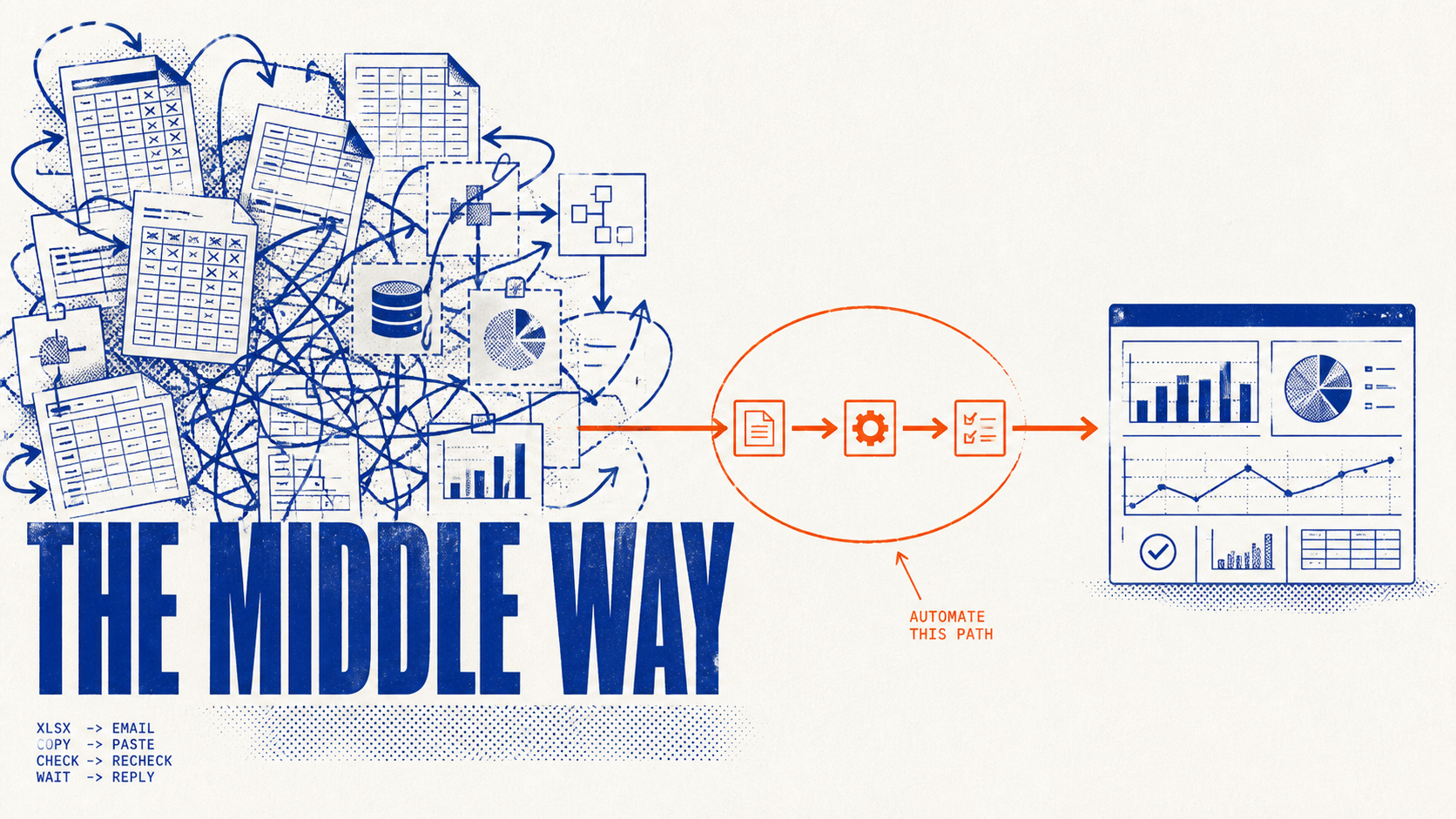
There’s a middle ground between “do nothing” and “buy SAP” that most SMBs don’t know exists.
Start by figuring out which processes actually deserve custom software. Not everything does. Some tasks are fine with off-the-shelf tools. Some are fine with spreadsheets. The ones worth building for are the tasks that eat the most hours, cause the most errors, or directly affect your customers’ experience. If you’re not sure where that line is, we wrote a whole framework for figuring out which processes are worth automating. That’s the core principle behind scaling a business with no-code.
Then build only what you need. One tool that solves one expensive problem. For Blomma, it was an operations centre that connected orders, inventory, and delivery. Read the full Blomma case study →. For Major, it was a client-facing reporting dashboard. Neither needed 100 features. They needed the right 10.
Speed matters more than most people realise. Most of our projects go from kickoff to launch in about 8 weeks. That’s a constraint we set on purpose, because projects that drag on for 6 months tend to fail. Scope grows, requirements change, people lose faith. I’ve seen more projects die from taking too long than from moving too fast. A six-month timeline gives people permission to keep adding features, keep debating edge cases, keep perfecting things that don’t need to be perfect yet. An eight-week deadline creates a different kind of conversation. Instead of “what else should we add?” the question becomes “what can we cut and still solve the core problem?” That’s a much better question.
And plan for the next version from day one. The first build won’t be perfect. It’ll handle the core workflow and cut the biggest time waste. Then, once your team uses it for a few weeks, you’ll see what needs adjusting. Maybe the approval flow needs an extra step. Maybe the dashboard needs a different view. That’s normal. The point of building fast isn’t to build once and walk away. It’s to get something real in front of your team quickly so you can improve it based on how they actually use it, not how you imagined they’d use it.
The real cost comparison
For an SMB with 20 to 50 employees, the options break down like this:
Enterprise software (Salesforce, NetSuite, etc.) costs $50K to $200K+ in year one, including licensing, implementation, and customisation. Ongoing costs hit $20K to $80K per year. Implementation takes 3 to 9 months. You’ll need someone managing it full-time.
Hiring an internal developer sounds good until you factor in $80K to $150K per year in salary, plus 3 to 6 months before they ship anything useful, plus the management overhead, plus the risk that they build something only they understand. I talked to a company last year that hired a developer to build an internal tool. He did a great job. Then he left. Nobody on the team could change a single thing about the system he built. They ended up calling us to rebuild it from scratch.
Building custom with a small agency like ours costs $8K to $50K per project, goes live in 6 to 10 weeks, and you own the result. If you want a deeper look at what affects the price, we break it down in our guide on agency costs.
The math is clear. If your manual processes cost you $50K+ a year in wasted time (and for most growing SMBs, they do), a one-time project that cuts half of that pays for itself in months.
”We’ll do it ourselves”
I hear this a lot. “We’ll have our ops person build something in Airtable”, or “we’ll connect everything with Zapier.” Sometimes this works. If the task is simple, like sending a Slack notification when a form is submitted, Zapier is perfect.
But I’ve seen too many companies try to duct-tape together 15 Zapier automations with 3 Airtable bases and a Google Sheet that’s the load-bearing wall of the entire operation. It works until it doesn’t. And when it breaks, nobody knows where to look because the “system” was built in pieces by three different people over two years.
There’s also a ceiling on what DIY tools can do. They’re great for connecting two apps. They’re terrible at handling complex business logic, like “if this order is over $5,000 and the customer is in tier 2, route it to the regional manager for approval, unless it’s a repeat order from the last 30 days, in which case auto-approve.” Real businesses have rules like this. Zapier doesn’t. Some of those processes don’t need a full tool at all, just an AI agent that handles the judgment calls a Zapier chain can’t.
The question isn’t whether you can build it yourself. It’s whether you want your operations to depend on something that only one person understands. For most growing companies, the answer should be no.
Most SMBs assume they have two choices: live with broken processes or spend enterprise money fixing them. There’s a third option that sits right in the middle, and for companies in the $3M to $30M range, it’s almost always the smart move.
If your team is spending hours on work that should take minutes, the fix is simpler and cheaper than you think. It’s not free, but it’s a lot closer to reality than you’ve been told.
The third option is a custom-built tool, scoped for your exact process. We build them for SMBs like the ones in this post, using WeWeb for dashboards and data tools, Bubble for workflow-heavy apps, and n8n for the automation layer connecting it all.
*Your tools should work for your business, not the other way around. *Book a free intro call
Frequently asked questions
How do SMBs automate operations without expensive enterprise software?
They build custom internal tools, instead of relying on expensive enterprise software. Enterprise platforms like Salesforce, NetSuite, and SAP cost $50,000-$200,000 in year one and take 3-9 months to implement. A custom tool built for your specific bottleneck costs $8,000-$50,000, launches in 6-10 weeks, and eliminates the manual work that’s actually slowing you down. Off-the-shelf tools cover about 80% of your needs; custom builds handle the 20% where your competitive advantage lives.
What processes are worth automating first for a growing SMB?
Focus on the process costing the most in wasted time. The threshold that typically justifies a custom build is $50,000 or more annually in manual labor. Calculate it by asking how many people are involved, how many hours per week, and at what loaded cost. Cross-department handoffs, where data has to move between systems that don’t talk to each other, are usually the highest-value target.
What’s the ROI on custom automation tools for SMBs?
When done right, the ROI is high. A Spotify marketing agency built a custom reporting dashboard, cut reporting time by 80%, and tied $25,000+ in additional monthly growth to having faster data access. At $8,000-$50,000 for the build, it pays back in weeks. To find your break-even point, divide the build cost by your monthly labor savings.
Can Zapier or Make replace a custom internal tool?
For simple, linear automations, yes. For complex business logic with conditional routing based on multiple criteria, real-time data requirements, or workflows that need to handle exceptions gracefully, no. Zapier and Make hit a ceiling when logic gets conditional or when you need data from multiple systems to make a decision. Custom tools handle what automation platforms can’t.
How is a no-code custom tool different from enterprise software?
Enterprise software is built for companies ten times your size with full IT departments and implementation teams. It’s feature-rich and inflexible. You adapt to the software, not the other way around. A custom tool is built specifically for your workflow, with only the features you need, and typically takes 6-10 weeks to deliver rather than 6-9 months.
Himanshu runs NocodeAssistant, a development agency that builds internal tools and SaaS products for growing companies. He's worked directly with every client since 2019. Same person from kickoff to post-launch.
SAP and NetSuite are built for companies ten times your size. Here's why a $12,000 custom tool fixes more than a $150,000 ERP, and how to know which one you actually need.